Zillow is turning into a mortgage lender
The stock has lost roughly two thirds of its value. Its audience barely moved. The explanation is in a filing published just after the previous day's close.
Zillow Group closed at $33.76 on 6 August 2026, down 8.5 percent on the day. Evercore ISI had cut the stock that morning and halved its price target, from $80 to $40. The shares now trade below even that reduced figure, and 63 percent beneath a 52-week high of $90.22.
When an internet company loses most of its value, the natural assumption is that people stopped showing up. Zillow filed its quarterly report with the Securities and Exchange Commission the same morning. The filing says otherwise.
The audience barely moved
Zillow counted 2,529 million visits in the second quarter, against 2,590 million a year earlier. Average monthly unique users were 239 million, against 243 million. Both fell about 2 percent.
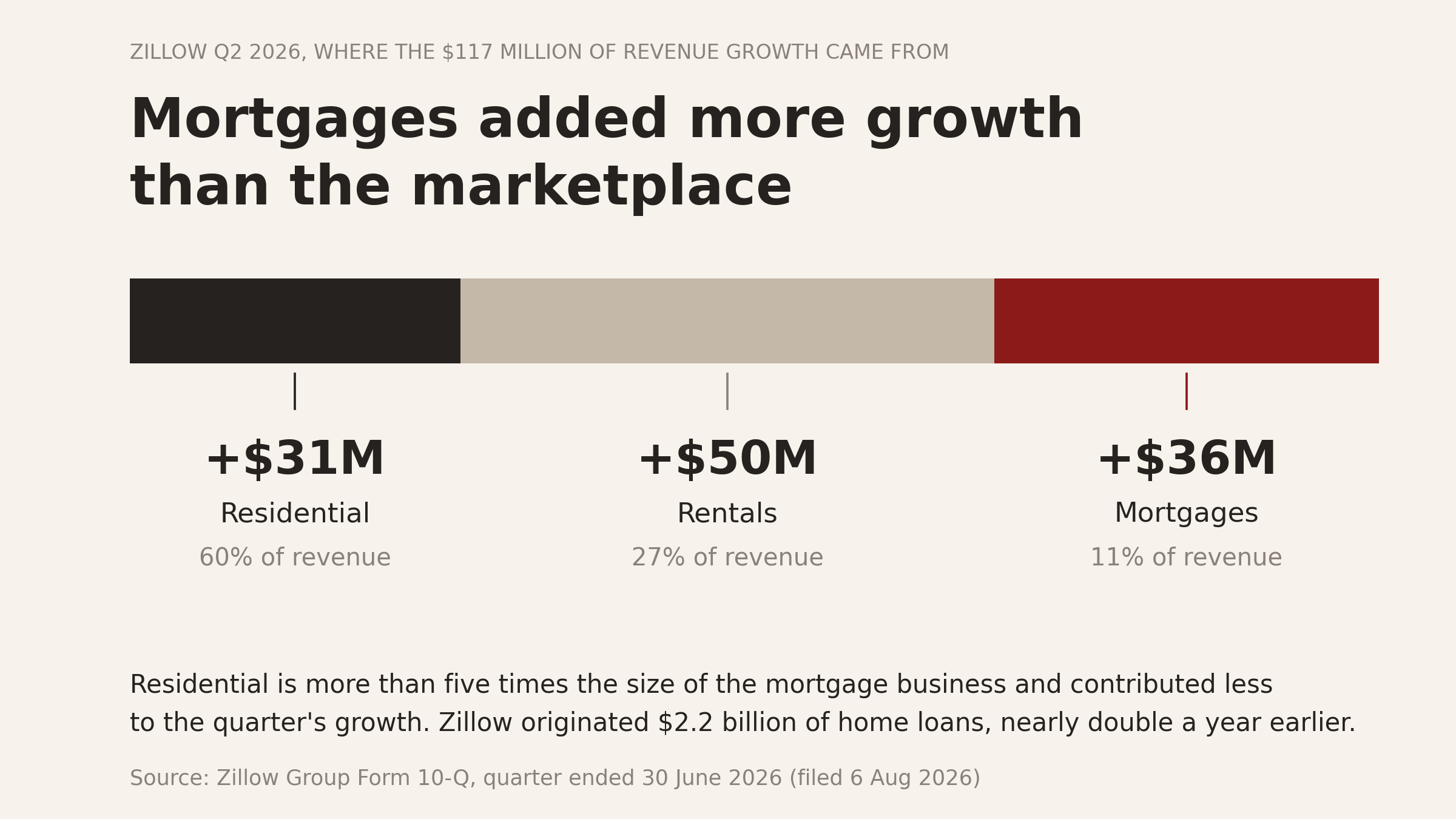
Revenue did not fall at all. Total revenue was $772 million, up from $655 million, an increase of 18 percent. That happened in the same quarter the market decided the company was worth roughly half as much.
The two facts are reconciled by where the growth came from.
Zillow, year over year change in the second quarter of 2026
Percent change
Bar chart plotting 1 series — Change against the second quarter of 2025 — across 6 points of measure. Values range from -2% to 94%. The full figures are available in the data table below the chart.
The audience shrank. The lending business nearly doubled.
Source Zillow Group, Form 10-Q for the quarter ended 30 June 2026.
The marketplace grew 7 percent
Zillow reports revenue in four categories. Residential is the advertising marketplace that connects buyers and sellers to agents. It is the business most people mean when they say Zillow, and it is the largest, at $465 million in the quarter.
It grew 7 percent. The filing attributes that increase to "an increase in residential revenue per visit." Visits fell and revenue per visit rose, which is monetisation rather than expansion.
Rentals grew 31 percent, to $209 million. Other revenue, which is display advertising, was flat at $14 million. Mortgages grew 75 percent, to $84 million.
Zillow revenue by category
$ million
Bar chart plotting 2 series — Q2 2025, Q2 2026 — across 4 points of segment. Values range from 14 to 465. The full figures are available in the data table below the chart.
Residential remains the largest business by a wide margin, and the slowest growing.
Source Zillow Group, Form 10-Q for the quarter ended 30 June 2026.
Zillow wrote $2.2 billion of home loans
The mortgage revenue line understates what sits behind it. Zillow Home Loans originated $2,181 million of mortgages during the quarter, against $1,126 million a year earlier. Volume grew 94 percent. Almost all of it was purchase lending, which grew 95 percent. Refinancing, which rises and falls with interest rates, was $7 million and is a rounding error in the total.
Zillow is no longer only selling advertising to mortgage lenders. It is the mortgage lender.
Loan origination volume through Zillow Home Loans
$ million
Bar chart plotting 2 series — Purchase, Refinance — across 2 points of period. Values range from 7 to 2,174. The full figures are available in the data table below the chart.
Purchase lending, which follows housing transactions rather than interest rates, is almost the entire book.
Source Zillow Group, Form 10-Q for the quarter ended 30 June 2026.
The money is borrowed, and the lines are uncommitted
Originating a mortgage requires cash before it produces revenue. The lender advances the full loan at closing and recovers the money when the loan is sold into the secondary market, typically within weeks. Zillow funds that gap with master repurchase agreements, which are short term borrowing facilities secured against the loans themselves.
At 30 June the company had drawn $465 million against $700 million of capacity, up from $364 million at the end of December. The lenders are JPMorgan Chase, Bank of Montreal, Bank of Nova Scotia and UBS. Weighted average interest rates ran between 5.08 and 5.20 percent. Zillow had pledged $487 million of mortgage loans held for sale as collateral.
Zillow master repurchase agreements at 30 June 2026
$ million
Bar chart plotting 2 series — Drawn, Maximum capacity — across 4 points of lender. Values range from 73 to 200. The full figures are available in the data table below the chart.
Capacity is described in the filing as primarily uncommitted, meaning the banks are not obliged to lend against it.
Source Zillow Group, Form 10-Q for the quarter ended 30 June 2026.
One clause in the filing describes the terms of that capacity. It is, in Zillow's own words, "primarily uncommitted."
Uncommitted means the bank is not obliged to lend. It may decline to fund on any given day. For a business that must advance cash at every closing, an uncommitted line is ample in ordinary conditions and absent in exactly the conditions where it would matter.
Why growth of 18 percent did not help
An advertising marketplace and a mortgage originator are not valued alike, and the gap is wide.
Marketplace revenue is asset light. Zillow does not fund it, does not carry it on the balance sheet, and does not need to borrow to produce more of it. Origination revenue is the opposite. Every dollar of it requires borrowed cash, is earned once per transaction, and falls away when housing volumes do.
A company whose growth comes increasingly from the second kind of revenue is a different company, and it earns a different multiple, whatever the consolidated growth rate looks like.
Two other figures in the quarter point the same way. Zillow recorded $36 million of restructuring costs, against nothing a year earlier, and told investors it expects headcount expenses to fall again in the third quarter. It reported a net loss of $4 million.
What would settle it
Three things would show whether this is a transition or a drift.
Whether Residential revenue keeps shrinking as a share of the total. Zillow has already guided it to fall in absolute terms in the third quarter as it moves consumers onto an integrated transaction.
Whether any of the $700 million of repurchase capacity converts from uncommitted to committed. That would show what the banks make of the business.
Gain on sale margins on the loans, which determine whether doubling volume doubles the economics or only doubles the exposure.
None of this is concealed. It was filed publicly just after the close the day before the stock fell.
Sources
- Zillow Group, Inc., Form 10-Q for the quarterly period ended 30 June 2026 (filed 5 August 2026) (opens in a new tab)SEC EDGARAccessed 10 August 2026
- Zillow Group, Inc., Form 8-K, second quarter 2026 results (filed 5 August 2026) (opens in a new tab)SEC EDGARAccessed 10 August 2026
Subscribe
Each note by email when it is published.