SpaceX owes $13bn to a firm run by one of its own directors
Its first quarterly report shows the AI hardware bought at pace this year is financed by a lender whose founder sits on the board. The arrangement nearly tripled in six months.
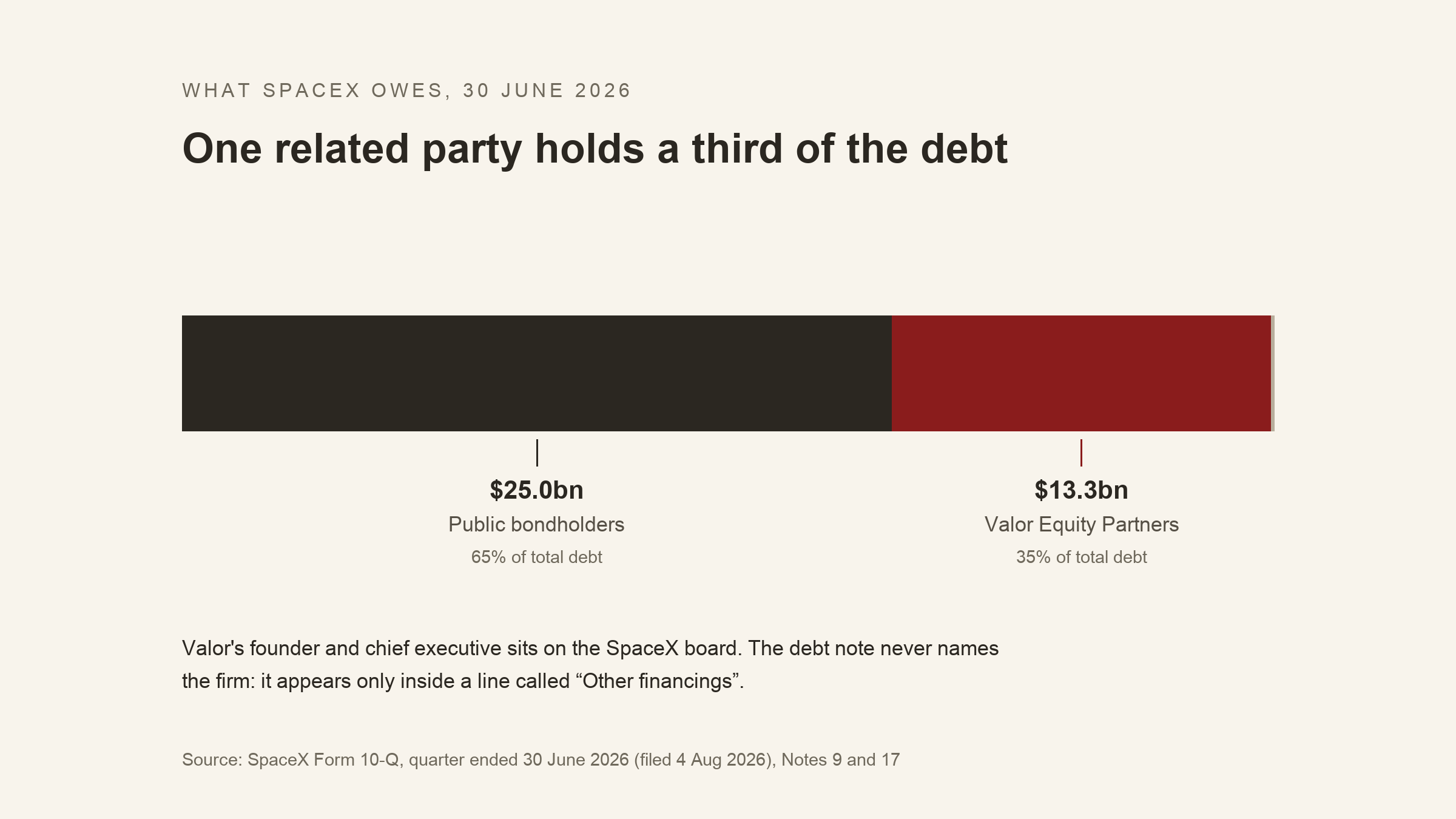
SpaceX owes $13.3 billion to Valor Equity Partners, an investment firm whose founder and chief executive, Antonio Gracias, sits on the SpaceX board. The money paid for AI infrastructure hardware. Six months earlier the company owed Valor about a third of that.
The relationship is disclosed, in Note 17 of the company's first quarterly report as a public company, filed on 4 August. It has not been much discussed. Most coverage of that filing worked from the earnings call: revenue up, losses continuing, shares down from their June high. The governance arrangement sitting underneath the AI build got less attention.
What the arrangement is
A sale-leaseback is a common way to turn owned equipment into cash. A company sells the asset to a financier and rents it back. The gear keeps working, the cash arrives early, and the asset leaves the balance sheet.
SpaceX's version does not work that way. The filing describes the April transaction as a "failed sale-leaseback", which is accounting language rather than a judgement about the deal. It means the arrangement did not meet the conditions for treating the transfer as a genuine sale. So the hardware stays on SpaceX's books, and the cash Valor provided is recorded as debt rather than as proceeds from a sale.
The practical effect is that SpaceX still owns the equipment, still owes the money, and pays interest on it. Note 17 says the company had entered into similar agreements with Valor before this one.
Why the number is easy to miss
Nothing in the debt note carries Valor's name. Note 9 lists SpaceX's borrowings by instrument, and the Valor obligations sit inside a line called "Other financings", a $13.4 billion catch-all with a footnote pointing at failed sale-leasebacks.
Reading the two notes together is what makes the scale visible. Essentially all of that "Other financings" line is Valor. Against total debt of roughly $38 billion, one related party accounts for about a third of what the company owes.
The interest is the more striking part. SpaceX paid $327 million of interest on the Valor arrangements last quarter, out of $629 million in interest expense across the whole company. More than half of what SpaceX pays to borrow goes to a firm represented on its own board.
What the filing does not say, and what it does
Related-party disclosure has a floor and a ceiling. The floor is that the relationship must be disclosed, and SpaceX has cleared it: the note names the firm, names the director, and gives the balances and the interest. The ceiling is everything a reader might reasonably want and does not get.
The filing does not say who negotiated the terms, whether independent directors reviewed them, or why a firm connected to the board was the lender rather than a bank or a leasing company. It does not explain what the alternatives were or whether they were sought.
One thing does cut in the company's favour, and it belongs in the same paragraph. The rate is not obviously generous. These arrangements carry an average fixed rate of 5.9 per cent. The senior notes SpaceX sold to public investors in June, in a $25 billion offering, priced between 5.350 and 6.650 per cent. On price alone, the related-party money looks like roughly what the market charged the same borrower at the same time. That is worth stating plainly, because the interesting question here is structural rather than a matter of anyone being overcharged.
Why SpaceX needed the money
The scale of the borrowing makes more sense next to what the company is building.
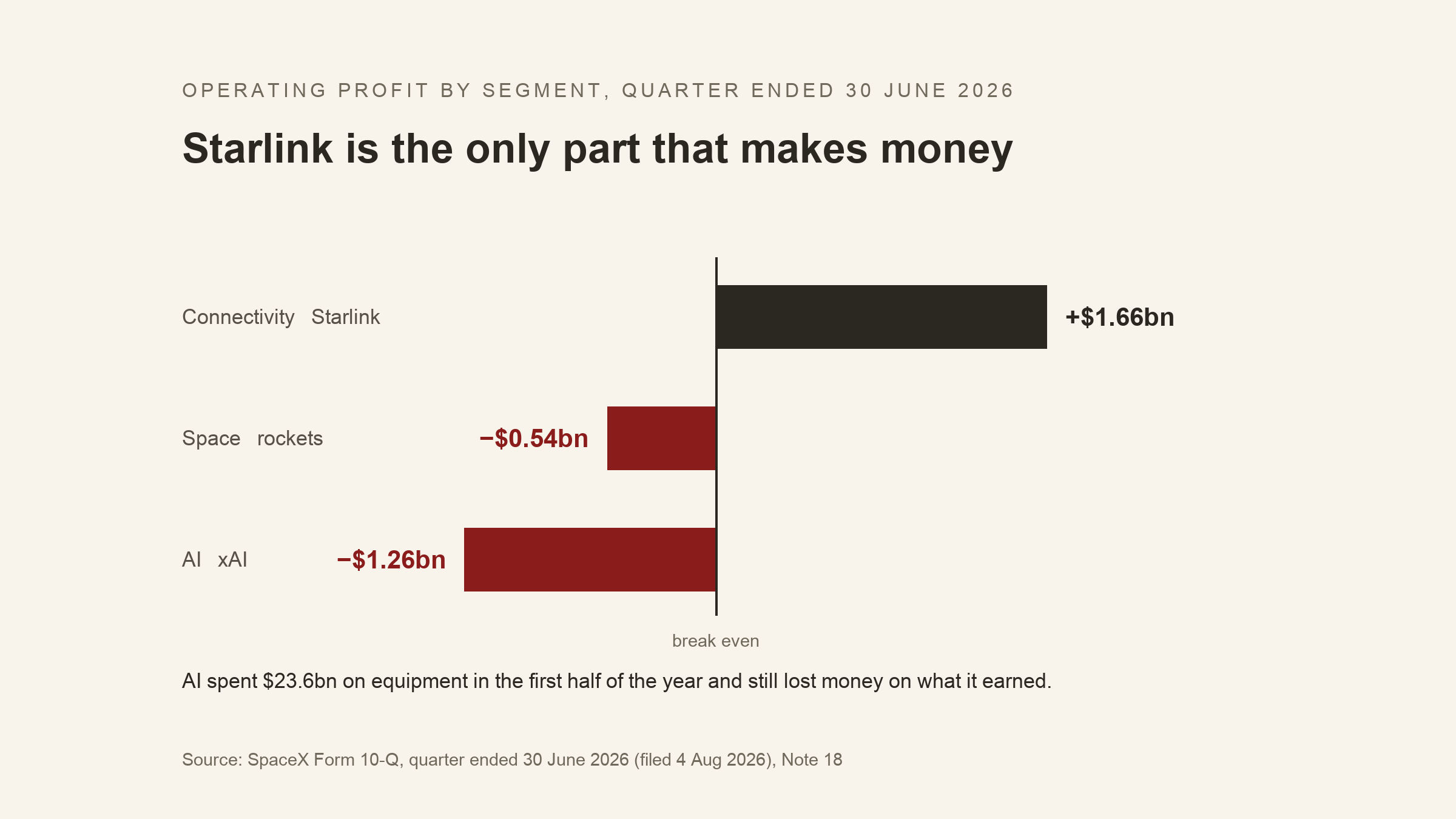
SpaceX now reports three segments: Space, Connectivity and AI. Space is the rockets. Connectivity is Starlink. AI is the business it acquired when it absorbed xAI in February.
In the first half of this year the company spent about $28 billion on property and equipment. Most of that went to AI. Space, the part of the company most people picture when they hear the name, took a small fraction of it and lost money on what it earned.
Starlink is the only one of the three that made an operating profit. It is also nowhere near large enough to fund the build on its own. Operations across the entire company generated roughly $3.5 billion of cash in the half, against that $28 billion of spending. The gap was closed by the June IPO, which raised about $85.7 billion, and by borrowing, including the Valor arrangements.
Seen that way, the related-party debt is not a curiosity in the footnotes. It is part of how one of the largest AI infrastructure programmes in the world is being paid for.
What would settle the open questions
A proxy statement would normally describe how related-party transactions are reviewed and approved, and by whom. SpaceX has not filed one yet. That document, when it arrives, is where a reader would look to find out whether independent directors passed on these arrangements and what process applied.
Short of that, a future filing that breaks the "Other financings" line into its components, or that states the review process directly, would answer most of what this one leaves open.
Until then, the checkable facts are these. A firm whose founder sits on the board has become SpaceX's largest single creditor after its public bondholders. That position nearly tripled in six months. And it now absorbs more interest than every other borrowing the company has.
Sources
- Space Exploration Technologies Corp, Form 10-Q for the quarter ended 30 June 2026, filed 4 August 2026 (opens in a new tab)SEC EDGARAccessed 5 August 2026
Subscribe
Each note by email when it is published.