Nvidia's customer financing is disclosed. Its effect on revenue is not.
A ledger of every Nvidia capital commitment to a customer that appears in an SEC filing, set against a revenue-concentration disclosure that names no one.
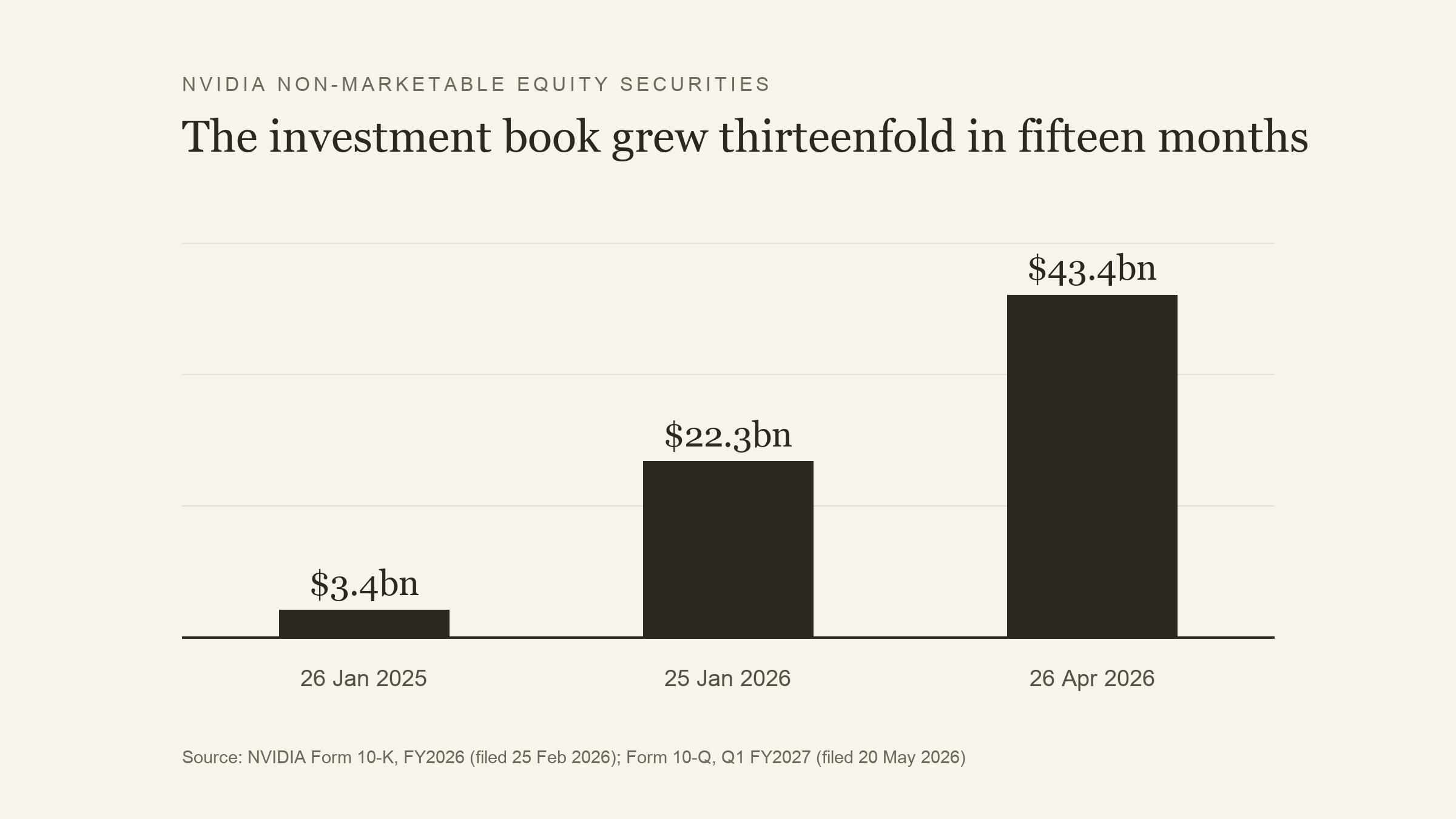
Nvidia closed fiscal 2026, the year ended 25 January 2026, with $215.9 billion of revenue, up 65 percent. In the same year it became one of the largest strategic investors in technology. The annual report discloses $17.5 billion put into private companies and infrastructure funds, primarily to support early-stage startups. The following quarter added $18.6 billion more.
Many of the companies receiving that capital also buy Nvidia chips. The question worth asking is how much of the revenue Nvidia books comes from counterparties Nvidia itself finances. This note builds the ledger from filings alone, and then says plainly what the ledger cannot prove.
It cannot prove a ratio. Nvidia discloses what it has invested, counterparty by counterparty. It discloses who its largest customers are only as anonymous percentages. The two disclosures never meet, and no arithmetic joins them.
The customers are large, and anonymous
Revenue concentration is disclosed the way accounting rules require and no further. Any direct customer above 10 percent of revenue gets a percentage. None gets a name.
Share of revenue from customers big enough to disclose
Percent of total revenue
Bar chart plotting 1 series — Combined share of disclosed customers — across 4 points of period. Values range from 34% to 61%. The full figures are available in the data table below the chart.
Accounting rules require a percentage for any direct customer above 10 percent of revenue, and nothing more. The first two bars are full fiscal years and the last two are single quarters, so they are not directly comparable.
Source Nvidia Form 10-K, FY2026 (filed 25 February 2026); Form 10-Q, Q3 FY2026 (filed 19 November 2025); Form 10-Q, Q1 FY2027 (filed 20 May 2026).
Direct customer is a broad label. Nvidia defines it to include add-in-board makers, distributors, ODMs, OEMs, cloud service providers, AI model makers and system integrators. A percentage in that note could belong to a distributor or to a hyperscaler, and a reader cannot tell which.
One sentence in the Q1 FY2027 filing comes closer than any other. Under Concentration of Revenue, Nvidia writes that it estimates “one AI research and deployment company contributed to a meaningful amount of our revenue by purchasing cloud services from our customers in the first quarter of fiscal year 2027.” The company is not named and the amount is not given. That is as close as any Nvidia filing comes to connecting a financed counterparty to revenue.
The investment book
Most of the financing sits in one balance-sheet line, non-marketable securities, and that line has done something unusual.
How the balance grew matters more than the total. A book that grew on revaluation would say little about what Nvidia has committed. One that grew on fresh money says a great deal.
How the investment book grew in fiscal 2026
$ billion
Bar chart plotting 1 series — Non-marketable securities — across 6 points of item. Values range from -0.85 to 22.25. The full figures are available in the data table below the chart.
Money actually deployed, rather than gains on holdings already owned, accounts for roughly 92 percent of the increase.
Source Nvidia Form 10-K, FY2026 (filed 25 February 2026).
A further $27 billion of investment commitments was outstanding at 26 April 2026, subject to certain contingencies, which Nvidia expects to fund through the remainder of fiscal 2027.
The ledger
| Counterparty | Instrument | Disclosed amount | Filing and note/item |
|---|---|---|---|
| Intel | Equity stake, 214.8m shares at $23.28 | $5.0bn | Nvidia Form 13F (Q4 2025 holdings, filed Feb 2026); Intel 8-K, Dec 2025 |
| CoreWeave | Equity, Class A at $87.20/share, 22.9m-share Jan 2026 tranche at a 6% discount to the 23 Jan 2026 close | $2.0bn | Nvidia newsroom 26 Jan 2026; Nvidia 13F |
| Nebius | Common shares plus pre-funded warrant, 22,256,412 Class A shares (9.3%) | ~$2.0bn stated deal value | Nvidia Schedule 13G, filed 20 July 2026 |
| CoreWeave | Capacity backstop: obligation to buy residual unsold capacity through 13 April 2032 | $6.3bn initial order value | CoreWeave 8-K, Item 1.01, filed 15 Sept 2025 |
| Unnamed partner(s) | Facility lease guarantees, warrants received, 5 to 7 year terms | $3.5bn max gross exposure, $712m escrow | Nvidia Q1 FY2027 10-Q, Note 8 |
Source: Nvidia FY2026 10-K (filed 25 Feb 2026); Nvidia Q1 FY2027 10-Q (filed 20 May 2026); CoreWeave 8-K (filed 15 Sept 2025); Nvidia Schedule 13G re Nebius (filed 20 July 2026)
| Disclosure | Amount | Filing and note |
|---|---|---|
| Non-marketable securities carrying value | $43.36bn at 26 Apr 2026 | Balance sheet / Note 6 |
| Future investment commitments | $27bn at 26 Apr 2026 | Note 6 |
| Multi-year cloud service purchase commitments, Nvidia as buyer, primarily for R&D | $30bn at 26 Apr 2026 | Note 10 |
Source: Nvidia Q1 FY2027 10-Q (filed 20 May 2026)
CoreWeave is the cleanest loop
CoreWeave buys Nvidia GPUs. Nvidia owns equity in CoreWeave. And under an order form dated 9 September 2025, Nvidia is obligated to purchase the residual unsold capacity through 13 April 2032, an arrangement with an initial value of $6.3 billion. The 8-K states the dual role in a single line: “In addition to the MSA, NVIDIA supplies the Company with NVIDIA GPUs and is a stockholder of the Company.” Nvidia's stake rose from about 7 percent in March 2025 to 11.5 percent in January 2026.
Why the ratio cannot be computed
To divide financed revenue by total revenue you need the revenue each financed counterparty books with Nvidia. Nvidia never discloses it. The concentration note is anonymous, and the financed neoclouds and model-makers appear, if at all, as unnamed indirect customers. The one sentence that links the two sides is deliberately unquantified. Nothing in the filings lets a reader attach a revenue number to CoreWeave, to Nebius, or to any company Nvidia has financed.
The timing runs the wrong way
The capital is committed now and the revenue, if it comes, arrives later. The CoreWeave backstop runs to 2032. The facility lease guarantees run five to seven years. The commitments fund through the rest of fiscal 2027. Revenue from the chips those counterparties buy is recognised on delivery, quarter by quarter. The exposure is disclosed and current. What it is meant to unlock is neither.
What is reported but not filed
The items below dominate the popular account of Nvidia's circular financing. None is confirmed as a line item in any Nvidia SEC filing reviewed for this note. Press coverage is used here to locate them, never as proof of a filed fact.
| Counterparty and item | Reported amount | Announced | Status in Nvidia's filings |
|---|---|---|---|
| OpenAI, letter of intent | Up to $100bn | 22 Sep 2025 | Not filed. Non-binding. Chief financial officer Colette Kress said on 2 December 2025 that no definitive agreement had been completed. |
| OpenAI, equity investment | $30bn | 27 Feb 2026 | Not filed. Larger than the $18.6bn of total private-company investment Nvidia disclosed for the quarter, so it cannot be reconciled to the filing. |
| OpenAI, Ohio data-centre backstop | ~$250bn | 26 Jul 2026 | Not filed. Would backstop lease and construction debt for a 10-gigawatt campus, not the chips. |
| OpenAI, chip-purchase financing | Up to $350bn | 26 Jul 2026 | Not filed. |
| Anthropic | Up to $10bn | 18 Nov 2025 | Named once, in the Q3 FY2026 risk factors, under language saying no assurance any investment will be completed. The name does not carry into the Q1 FY2027 10-Q. |
| Lambda, GPU leaseback | $1.5bn | Sep 2025 | Not filed as a named line. |
| Corning | Up to $3.2bn | May 2026 | Not filed as a named line. |
| IREN | Up to $2.1bn | May 2026 | Not filed as a named line. |
Source: Announcement dates and amounts per contemporaneous press reports. Status verified against Nvidia's FY2026 10-K, Q3 FY2026 10-Q and Q1 FY2027 10-Q.
The two largest numbers are the two that are not filed
$ billion
Bar chart plotting 1 series — Disclosed amount — across 4 points of item. Values range from 3.5 to 350. The full figures are available in the data table below the chart.
The largest guarantee Nvidia has actually disclosed is the $3.5 billion of facility lease guarantees. The two figures that dominate the popular account of its circular financing appear in no Nvidia filing at all. Full detail in the table above.
Source Nvidia Form 10-Q, Q1 FY2027 (filed 20 May 2026), Notes 6 and 8; CoreWeave Form 8-K (filed 15 September 2025); press reports as dated in the table above.
What would settle the open questions
A related-party or disaggregated revenue note naming CoreWeave, Nebius or any financed neocloud would convert the qualitative "one AI research and deployment company" sentence into a number.
An 8-K filing the OpenAI $30bn subscription agreement, or the Ohio backstop guarantee, would move those items from the reported column to the filed ledger.
CoreWeave's own 10-K or 10-Q disclosure of revenue attributable to Nvidia, or purchases from Nvidia, would let an analyst triangulate one side of the loop from the counterparty's filings.
Sources
- NVIDIA Corporation Form 10-K, FY2026, filed 25 Feb 2026 (opens in a new tab)SEC EDGARAccessed 4 August 2026
- NVIDIA Corporation Form 10-Q, Q1 FY2027, filed 20 May 2026 (opens in a new tab)SEC EDGARAccessed 4 August 2026
- NVIDIA Corporation Form 10-Q, Q3 FY2026, filed 19 Nov 2025 (opens in a new tab)SEC EDGARAccessed 4 August 2026
- CoreWeave, Inc. Form 8-K, event 9 Sept 2025, filed 15 Sept 2025 (opens in a new tab)SEC EDGARAccessed 4 August 2026
- NVIDIA Schedule 13G re Nebius Group N.V., filed 20 July 2026 (opens in a new tab)SEC EDGARAccessed 4 August 2026
- NVIDIA Announces Financial Results for Fourth Quarter and Fiscal 2026 (opens in a new tab)NVIDIA Investor RelationsAccessed 4 August 2026
- NVIDIA and CoreWeave Strengthen Collaboration to Accelerate Buildout of AI Factories (opens in a new tab)NVIDIA newsroomAccessed 4 August 2026
- OpenAI and NVIDIA Announce Strategic Partnership to Deploy 10 Gigawatts of NVIDIA Systems (opens in a new tab)NVIDIA newsroomAccessed 4 August 2026
- Microsoft, NVIDIA and Anthropic announce strategic partnerships (opens in a new tab)MicrosoftAccessed 4 August 2026
- NVIDIA and Intel to Develop AI Infrastructure and Personal Computing Products (opens in a new tab)NVIDIA newsroomAccessed 4 August 2026
- Nvidia CFO admits the $100 billion OpenAI megadeal still isn't definitive (opens in a new tab)FortuneAccessed 4 August 2026
- Nvidia and OpenAI in talks for up to $250 billion backstop (opens in a new tab)CNBCAccessed 4 August 2026
- NVIDIA Announces Financial Results for First Quarter Fiscal 2027 (opens in a new tab)NVIDIA newsroomAccessed 4 August 2026
- Cover photograph: NVIDIA sign, Scott Boulevard, Santa Clara, by Will Buckner. Licensed CC BY 2.0. (opens in a new tab)Wikimedia CommonsAccessed 10 August 2026
Subscribe
Each note by email when it is published.