Moderna Stock Explodes 177% on Cancer Vaccine Breakthrough
Moderna's shares nearly tripled on 19 August 2026 and Merck rose with them, adding roughly $86bn of market value between them in a single session. The press release behind the move never says how well the drug actually worked.
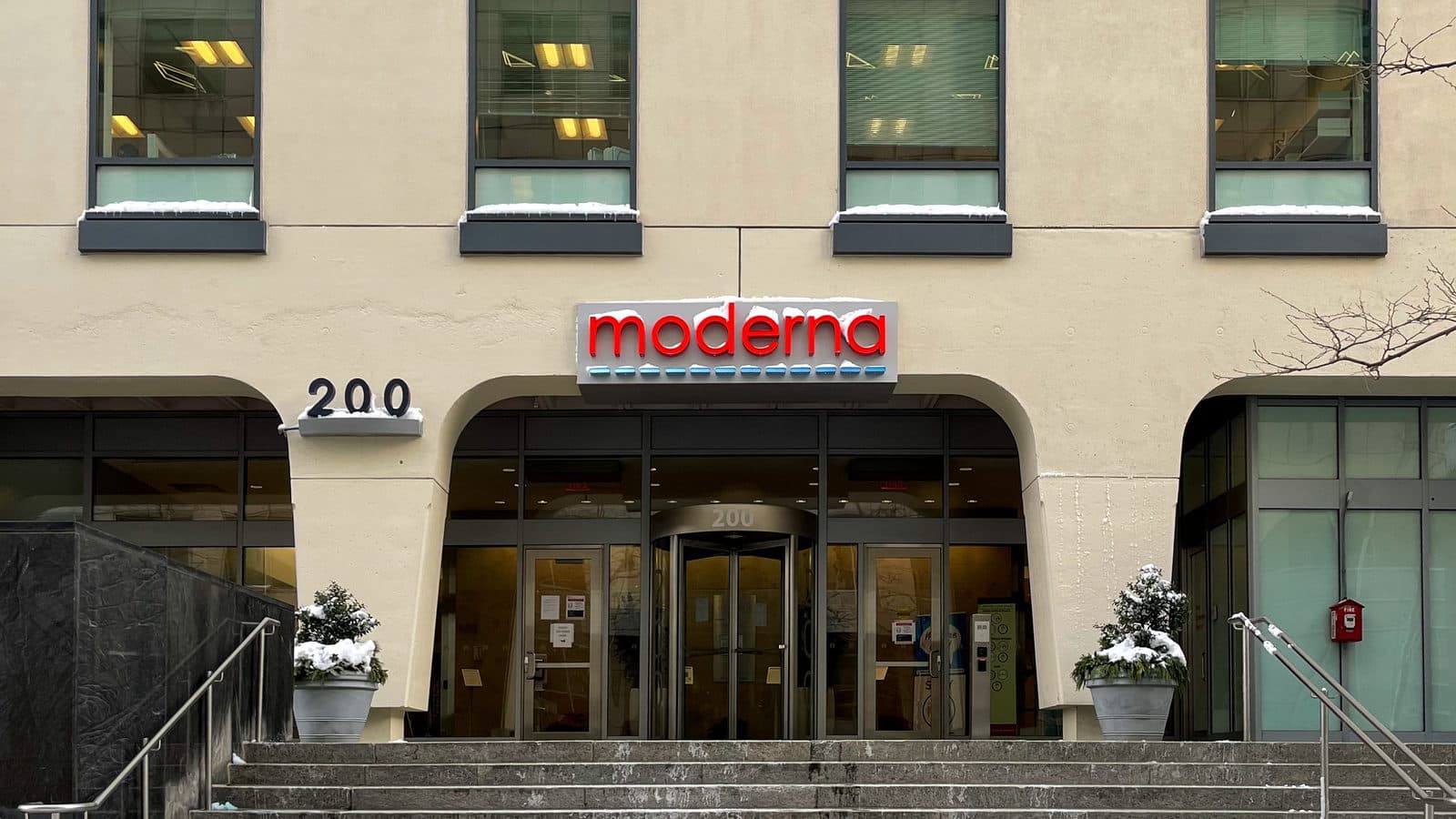
Photo: Fletcher, CC BY 4.0, via Wikimedia Commons
Moderna's shares closed on 19 August 2026 at almost three times the price of the evening before, a gain of 177% in a single session, which on the share count in the company's most recent quarterly report came to roughly $44.5bn of new market value.
Merck moved with it, rising by a little over a tenth, which on a company of that size worked out at about $42bn, so the two together gained roughly $86bn between one close and the next. Nothing was approved, nothing was sold and nothing was filed with the regulator that day, because the entire repricing rests on a single document.
That document was a joint press release issued that morning by the two companies, saying that their large melanoma trial had met both of the goals set for it in advance: patients went longer before their cancer came back, and longer before it spread to distant parts of the body. The study, known as INTerpath-001, was a Phase 3 trial, which is the last and largest round of testing a drug goes through before it is submitted for approval, and it enrolled more than a thousand patients whose melanoma had already been cut out by surgery. Two of every three of them were given the experimental vaccine, intismeran autogene, on top of Merck's established cancer drug Keytruda, and the rest were given Keytruda alone for about a year.
What the announcement does not contain
The release says that at a planned check on the data partway through the trial, before it had finished, the combination showed improvements described as statistically significant and clinically meaningful. What it never says is how large those improvements were, since it gives no figure for how much the risk of relapse fell, no measure of how likely such a result would be by chance alone, and no count of how many patients in either group saw their cancer return. Whether the vaccine helps people live longer is described as still being evaluated, and on side effects the release offers only that the profiles were consistent with previously reported studies with no new signals observed, without publishing a single rate for this trial.
The hard numbers that do appear in the release belong to a different study altogether. KEYNOTE-942 was an earlier and much smaller trial, roughly a seventh the size of the one being announced, and its results were published in The Lancet before being updated at a cancer conference this year. After five years it showed a 49% reduction in the risk of the cancer returning or the patient dying, and a larger reduction again in the risk of the disease spreading elsewhere in the body. Those reductions are quoted in the form doctors use for them, a hazard ratio, and the range of uncertainty around the first of the two stretches almost as far as the point at which the vaccine would have made no difference at all. Both companies say the results of the larger trial will be presented at a future medical meeting.
Both halves of the partnership repriced
Moderna does not own the drug on its own, and its latest quarterly filing sets out the arrangement. Merck took up its option on the therapy in September 2022 and paid a fee of $250 million for it that October, and since then, in the filing's words, costs and any profits or losses are generally shared equally on a worldwide basis. Moderna is responsible for making the material and Merck generally leads the clinical trials, and the whole thing is treated in the accounts as a collaboration between two partners rather than as one company selling something to the other.
The two gains in market value therefore sit close to one another, which is what you would expect, because they are two valuations of the same half-owned asset arrived at by two different sets of buyers on the same afternoon. The gulf between the headline percentages says nothing about how the drug is owned and everything about where the two companies started, since Merck is a far larger business that already sells Keytruda at scale, while Moderna sells very little.
One day, two halves of the same drug
$bn
Bar chart plotting 1 series — Market value added, $bn — across 2 points of measure. Values range from 42 to 44.5. The full figures are available in the data table below the chart.
Change in market capitalisation on 19 August 2026. Moderna: 399,235,889 shares from its Q2 2026 10-Q cover page, multiplied by the $111.42 move. Merck: approximately 2.47 billion shares multiplied by the $17.03 move. Both figures are approximate because share counts are reported as of a date before the close.
Source Moderna and Merck Forms 10-Q for the quarter ended 30 June 2026; closing prices for 19 August 2026
Against the size of the company
What Moderna spends on the programme is disclosed, and it is not much. In the first six months of 2026 the company booked just under $200 million of expense on the collaboration once Merck's share of the bill is taken out, slightly less than it spent over the same months a year earlier, against revenue that remains modest and losses that do not. The single day's increase in market value came to several times the entire book value of the company, and to roughly 225 times that half-year of spending on the programme that produced it.
The readout was not itself a surprise, only its timing, since the quarterly report filed a few weeks earlier had already told shareholders that the melanoma study was fully enrolled and that data were expected potentially in 2026. Nine trials of intismeran are under way in all, across melanoma, lung cancer, bladder cancer and cancer of the kidney.
The sector move
The rest of the sector was carried along with it, as the main biotechnology index rose more than 6% on the day and the two largest biotechnology funds tracked by investors rose by roughly the same amount. The broad market barely moved at all, with the S&P 500 and the Nasdaq Composite each up by a fraction of a percent, which makes this one drug rather than a general change in appetite for risk.
As of the close on 19 August, Moderna had not filed anything with the regulator about the results, and it did not have to, because the rule governing how companies release market moving news accepts a widely distributed press release as disclosure enough, so nothing at all is missing from the filing record. What is missing instead is the size of the effect, and an independent committee of doctors monitoring the trial has already seen those numbers and the two companies have chosen to hold them back for a conference, so until that presentation the whole of the roughly $86bn added in a single day rests on the phrase statistically significant and clinically meaningful, and on a risk reduction borrowed from a trial roughly one seventh the size of the one being announced.
Sources
- Moderna, Inc. Form 10-Q for the quarterly period ended 30 June 2026 (opens in a new tab)U.S. Securities and Exchange Commission
- INTerpath-001 (NCT05933577) trial record (opens in a new tab)ClinicalTrials.gov
Subscribe
Each note by email when it is published.