The Market Is Eating Itself
Six companies, one circle of money. It leaves as capital spending and comes back as profit, and much of it never moves as cash.
The largest companies in the world have just reported, and between them they have printed some of the best numbers in their histories. Alphabet nearly quadrupled its profit, Amazon tripled its own, and Meta grew revenue by 28 percent while earning less money than it did a year ago.
Follow the money through those results and it runs in a circle. One company's capital spending is the next company's revenue, that revenue funds the AI labs, the labs spend it on chips, and the chip maker turns around and buys cloud capacity back from the companies it has just sold to. At the end of the loop the whole arrangement is marked up and booked as profit.
Very little of it moves as cash at any point along the way.
| Company | What it pays out | What it books |
|---|---|---|
| Meta | $349.31bn of non-cancelable commitments, mostly third-party cloud | Revenue up 28 percent, profit down 14 percent |
| Microsoft | $11.9bn funded to OpenAI of $13.0bn committed | $24.1bn of revenue from OpenAI, plus a $6.5bn net gain |
| Amazon | $15bn committed to Anthropic, primary cloud provider | $50.5bn markup, plus $42.0bn through OCI |
| Alphabet | Up to $40bn committed to Anthropic, $10bn upfront | $99.0bn of gains on equity securities |
| Nvidia | $27bn of investment commitments, $30bn of cloud purchases | Three unnamed customers are 54 percent of revenue |
Source: Quarterly and annual reports of Meta, Microsoft, Amazon, Alphabet and Nvidia, filed between May and July 2026.
Meta spends
Meta has signed $349.31 billion of contracts it cannot cancel, most of them for third-party cloud capacity, and it discloses the figure in a risk factor rather than anywhere in the accounts.
That number is a cost to Meta and future revenue for Microsoft, Amazon and Google, which is the first turn of the circle. In the same quarter Meta sold more advertising than in any quarter of its history and earned less money doing it.
Meta, second quarter 2026 against second quarter 2025
Percent change
Bar chart plotting 1 series — Change against Q2 2025 — across 4 points of measure. Values range from -14% to 28%. The full figures are available in the data table below the chart.
Revenue grew by more than a quarter. Every measure of profit below it shrank.
Source Meta Platforms, Form 10-Q for the quarter ended 30 June 2026.
The clouds collect, then lend it back
Microsoft, Amazon and Google sell the capacity that Meta and everyone else is committing to, and they also fund the customers who buy it.
Satya Nadella's Microsoft booked $24.1 billion of revenue from OpenAI in fiscal 2026 and was still owed $6.0 billion of it at year end, having funded $11.9 billion of a $13.0 billion commitment. It owns roughly a quarter of OpenAI on an as-converted basis, which is enough to make its largest AI customer a related party.
Microsoft also booked a $6.5 billion net gain on that stake, against a $4.8 billion loss the year before, and the filing attributes the swing primarily to dilution from the OpenAI recapitalisation. The company recorded a profit, in other words, because its share of OpenAI got smaller.
Amazon has committed $15 billion to Anthropic and serves as its primary cloud provider, while Alphabet committed up to $40 billion in April, $10 billion of it upfront, and hosts Claude as well.
Nvidia sells the chips, then buys the capacity
The labs spend that money on chips, and Nvidia puts a great deal of the proceeds straight back into the market it has just sold into.
Its book of private stakes grew from $3.39 billion to $43.36 billion in fifteen months, investment commitments now stand at $27 billion against $6.5 billion two quarters earlier, and it has signed $30 billion of multi-year cloud purchase commitments, buying capacity from companies that are themselves its customers.
Three direct customers account for 21, 17 and 16 percent of revenue, and Nvidia names none of them. Jensen Huang said in March that the $10 billion Nvidia put into Anthropic and the $30 billion it put into OpenAI were likely its last investments in either company, because both were heading for public markets.
Nvidia's stake book, fifteen months
US$ billions
Bar chart plotting 1 series — Non-marketable equity securities — across 3 points of period. Values range from 3.39 to 43.36. The full figures are available in the data table below the chart.
A thirteenfold increase. Many of the companies receiving the capital also buy Nvidia chips.
Source Nvidia Corporation, Forms 10-Q and 10-K, FY2026 and Q1 FY2027.
The circle closes as profit
Alphabet reported net income of $112.2 billion for the June quarter against $28.2 billion a year earlier, and while operating income grew a healthy 30 percent, gains on equity securities came to $99.0 billion.
Amazon reported $62.6 billion against $18.2 billion, driven by a $50.5 billion markup on its Anthropic stake, with a further $42.0 billion running through other comprehensive income where it never reaches earnings per share at all.
Neither company has sold any part of what it marked up, and neither is required to before booking the gain.
How much of the quarter was a markup
Percent of net income
Bar chart plotting 1 series — Share of net income from investment gains — across 2 points of company. Values range from 81% to 88%. The full figures are available in the data table below the chart.
Gains on holdings neither company sold, as a share of reported net income for the June quarter.
Source Alphabet and Amazon.com, Forms 10-Q for the quarter ended 30 June 2026.
How a markup becomes profit
The accounting rules allow this. Under ASC 321 a company holding a private stake may carry it at cost until an observable transaction occurs, which Alphabet describes in its own filing as observable transactions for identical or similar investments of the same issuer.
Somebody else buys at a price you had no part in setting, and you book the difference as profit.
The transaction that mattered this quarter was Anthropic's Series H, announced on 28 May 2026, which raised $65 billion at a $965 billion valuation against the $380 billion the company had been priced at in February. Ten investment firms agreed that price in a private negotiation, and it flowed from there into the reported earnings of two of the largest companies in the S&P 500.
None of the parties around that price were strangers to the company being priced.
| Party | Role in the Series H | Other relationship with Anthropic |
|---|---|---|
| Altimeter, Dragoneer, Greenoaks, Sequoia | Lead investors | None disclosed |
| Capital Group, Coatue, D1, GIC, ICONIQ, XN | Co-lead investors | None disclosed |
| Micron, Samsung, SK hynix | Named as strategic infrastructure partners | Memory makers supplying the compute buildout |
| Amazon | Not a new investor | $15bn already committed, primary cloud provider, booked $50.5bn |
| Alphabet | Not named in the round | Roughly 14 percent holder, $40bn committed, cloud and TPU capacity |
| Microsoft | Not named in the round | Azure hosts Claude |
| Nvidia | Not named in the round | $10bn investment closed earlier in 2026 |
Source: Anthropic, Series H announcement, 28 May 2026, with relationships from company filings and contemporaneous reporting.
Alphabet booked a gain on shares it cannot sell
SpaceX listed on Nasdaq on 12 June 2026, eighteen days before Alphabet's quarter ended, and Alphabet held $94.1 billion of it at the close, $14.1 billion of which is restricted until the second half of 2027.
The gain sits in this quarter's earnings even though the shares behind part of it cannot be sold for another year.
The cash went the other way
Record profits arrived in a quarter when the money was moving in the opposite direction. Alphabet generated $39.1 billion of operating cash and spent $44.9 billion on capital expenditure, while Amazon's free cash flow over the past year was negative $7.6 billion against positive $18.2 billion a year earlier.
Profit against cash
US$ billions
Bar chart plotting 1 series — Alphabet, quarter ended 30 June 2026 — across 3 points of measure. Values range from 39.1 to 112.2. The full figures are available in the data table below the chart.
The largest reported profit in the company's history, in a quarter when it spent more cash than it generated.
Source Alphabet Inc., Form 10-Q for the quarter ended 30 June 2026.
What would settle it
Three disclosures would close the gap, and none of them are required today: a breakdown of the gain on equity securities by issuer, the identity and date of the transaction that triggered each remeasurement, and, where a company marks up a stake in a business it also sells to, the money running in both directions.
Until then, the arithmetic belongs to the people who set the price.
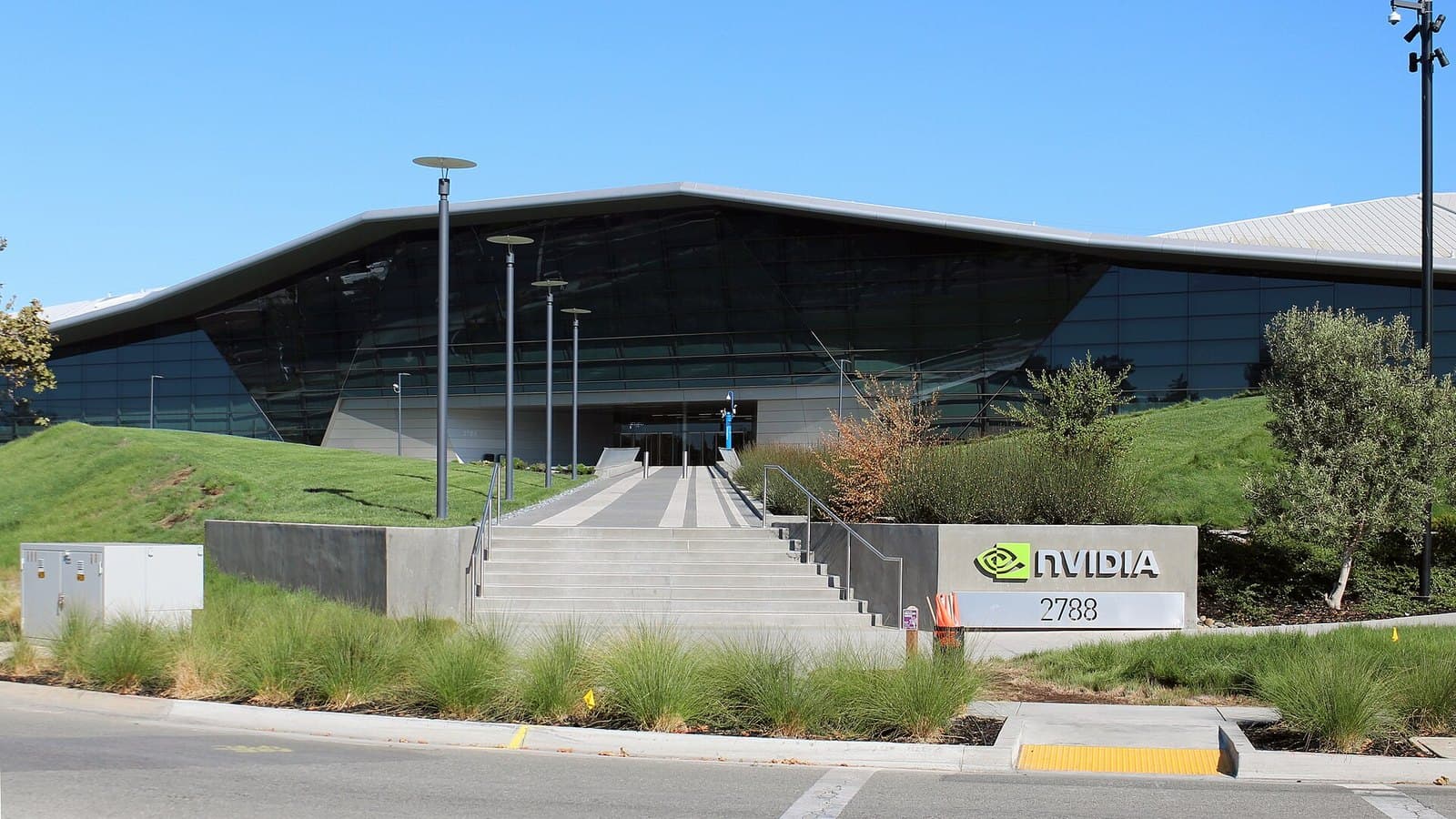
Cover photograph: Nvidia headquarters, Santa Clara (opens in a new tab) by Coolcaesar, via Wikimedia Commons, licensed CC BY-SA 4.0 (opens in a new tab). Cropped and resized from the original.
Sources
- Alphabet Inc., Form 10-Q for the quarterly period ended 30 June 2026 (filed 23 July 2026) (opens in a new tab)U.S. Securities and Exchange Commission
- Amazon.com Inc., Form 10-Q for the quarterly period ended 30 June 2026 (filed 31 July 2026) (opens in a new tab)U.S. Securities and Exchange Commission
- Microsoft Corporation, Form 10-K for the fiscal year ended 30 June 2026 (filed 29 July 2026) (opens in a new tab)U.S. Securities and Exchange Commission
- Meta Platforms Inc., Form 10-Q for the quarterly period ended 30 June 2026 (opens in a new tab)U.S. Securities and Exchange Commission
- Nvidia Corporation, Form 10-Q for the quarter ended 26 April 2026 (filed 20 May 2026) (opens in a new tab)U.S. Securities and Exchange Commission
Subscribe
Each note by email when it is published.