Amazon's stake in Anthropic out-earned Amazon
Net income tripled to $62.6 billion. A markup on a private holding it has not sold was $50.5 billion of it, and a second gain of $42.0 billion never reaches net income at all.
Amazon reported the largest quarterly profit in its history on 30 July. Net income was $62.6 billion, against $18.2 billion in the same quarter last year. Earnings per diluted share went from $1.68 to $5.75.
The operating business had a strong quarter, and it did not produce most of that. Operating income was $27.5 billion, up 43 percent. AWS grew 37 percent, its fastest in eighteen quarters. “AWS is booming,” Andy Jassy, Amazon's president and chief executive, said in the release, and on the operating numbers he is right.
Everything between operating income and net income is something else.
Three measures of the same quarter
$ billion
Bar chart plotting 2 series — Q2 2025, Q2 2026 — across 3 points of measure. Values range from 18.2 to 104.1. The full figures are available in the data table below the chart.
Only the first is the operating business. The distance between the first and the third is almost entirely one investment.
Source Amazon.com, Inc., Form 10-Q, quarter ended 30 June 2026.
A price somebody else paid
The earnings release carried one line about it, and the line is accurate:
Second quarter 2026 net income includes non-operating pre-tax other income of $53.4 billion, primarily from our investments in Anthropic.
The quarterly report, filed the same evening, says what that is:
The upward adjustments relating to equity investments in private companies of $50.5 billion in Q2 2026 and $62.8 billion for the six months ended June 30, 2026 reflect observable changes in prices, primarily from our nonvoting preferred stock in Anthropic.
Observable changes in prices is the mechanism, and it is worth being plain about what it means. Amazon holds nonvoting preferred stock in a private company. When that company sells shares to someone else at a higher price, Amazon marks its own holding up to match, and the increase runs through the income statement as profit.
Nothing was sold. No cash moved. The price was set in a transaction whose terms Amazon reports observing rather than setting. The gain is real in the sense that the accounting rules require it and the auditors accept it. It is not real in the sense that anyone can spend it.
The larger gain that never reaches net income
There is a second position in the same company, it produced a second gain, and the earnings release does not mention it.
Alongside the preferred stock, Amazon holds convertible notes in Anthropic. Those are accounted for as available-for-sale debt securities, and their gains do not pass through the income statement at all. They go to other comprehensive income, a separate line that sits below net income and is easy to skip.
In the second quarter that line was $42.0 billion, net of $13.7 billion of tax. It is larger, before tax, than the markup that produced the record profit, and it has no effect on earnings per share.
What one investment produced, against what AWS did
$ billion
Bar chart plotting 1 series — Second quarter 2026 — across 3 points of item. Values range from 16.6 to 50.5. The full figures are available in the data table below the chart.
AWS is Amazon's most profitable segment. In the second quarter, each of the two Anthropic-related gains was larger than all of it.
Source Amazon.com, Inc., Form 10-Q, quarter ended 30 June 2026; Form 8-K, Exhibit 99.1, 30 July 2026. The comprehensive income figure is net of $13.7bn of tax.
Comprehensive income, the measure that captures both, was $104.1 billion against $21.5 billion a year earlier.
The cash flow statement takes it straight back out
The clearest evidence that none of this is cash is that Amazon removes it. The cash flow statement begins at net income and subtracts $53.4 billion of non-operating income in the first few lines, because no cash arrived. Operating cash flow for the quarter was $45.4 billion, less than the markup that sat above it.
Meanwhile the company spent $54.2 billion on property and equipment in the quarter alone. Measured over twelve months, free cash flow was an outflow of $7.6 billion, against an inflow of $18.2 billion a year earlier. Capital spending rose by $66.1 billion over that period, which Amazon attributes primarily to artificial intelligence.
So the same quarter that produced the largest paper profit in the company's history sits inside a twelve month period in which the business consumed more cash than it generated.
Free cash flow, trailing twelve months
$ billion
Bar chart plotting 1 series — Free cash flow — across 2 points of period. Values range from -7.6 to 18.2. The full figures are available in the data table below the chart.
Capital spending rose $66.1bn year over year, which the company attributes primarily to artificial intelligence.
Source Amazon.com, Inc., Form 10-Q, quarter ended 30 June 2026. Operating cash flow less purchases of property and equipment, net of proceeds from sales and incentives.
And a tax charge on money nobody has received
The gain brought a tax charge with it. Deferred income taxes in the quarter were $17.7 billion. In the same quarter last year they were $11 million.
Deferred means it is not payable now. It is an obligation recorded against a gain that has not been realised, and it would become payable only in circumstances that have not happened yet.
| Figure | Q2 2026 | Statement it appears in | Cash? |
|---|---|---|---|
| Operating income | $27.5bn | Income statement, above the line | Mostly, in time |
| Markup on private equity investments | $50.5bn | Income statement, other income | No |
| Gain on available-for-sale debt securities | $42.0bn net of tax | Other comprehensive income | No |
| Deferred income taxes | $17.7bn | Cash flow, added back | No |
| Non-operating income reversed out | ($53.4bn) | Cash flow, subtracted | No |
| Purchases of property and equipment | ($54.2bn) | Cash flow, investing | Yes |
Source: Amazon.com, Inc., Form 10-Q for the quarterly period ended 30 June 2026.
What the number is, and what it is not
Four things should travel with this figure, and the fourth is the one most likely to be got wrong.
It is not an error or a trick. Marking a private holding to an observed price is what the accounting standard requires once such a price exists.
It is not revenue, and it is not cash. It changes the carrying value of an asset Amazon still holds.
It can reverse. A mark that moves up on an observed price moves down on one too, and the same line was $49 million in the same quarter a year ago.
You cannot strip it out by subtraction. Taking $50.5 billion of pre-tax gain off $62.6 billion of after-tax profit gives about $12 billion, and that number is wrong, because the gain carries its own tax. The honest way to see the operating business is the operating income line, which excludes all of this and grew 43 percent.
What would settle it
Three things would answer what this figure is worth. The price of Anthropic's next financing round, which is what would move the mark again in either direction. Whether Amazon ever converts, sells, or is able to sell any part of the position. And the third quarter filing, which will show whether the mark holds, and whether free cash flow stays negative while capital spending runs at this rate.
Until then the checkable facts are these. Amazon's operating business grew 43 percent. Its reported profit tripled. Most of the difference is the price somebody else paid for shares in a company Amazon does not control, and the cash flow statement removes all of it.
Sources
- Amazon.com, Inc., Form 10-Q for the quarterly period ended 30 June 2026 (filed 31 July 2026) (opens in a new tab)SEC EDGARAccessed 11 August 2026
- Amazon.com, Inc., Form 8-K, Exhibit 99.1: second quarter 2026 results (filed 30 July 2026) (opens in a new tab)SEC EDGARAccessed 11 August 2026
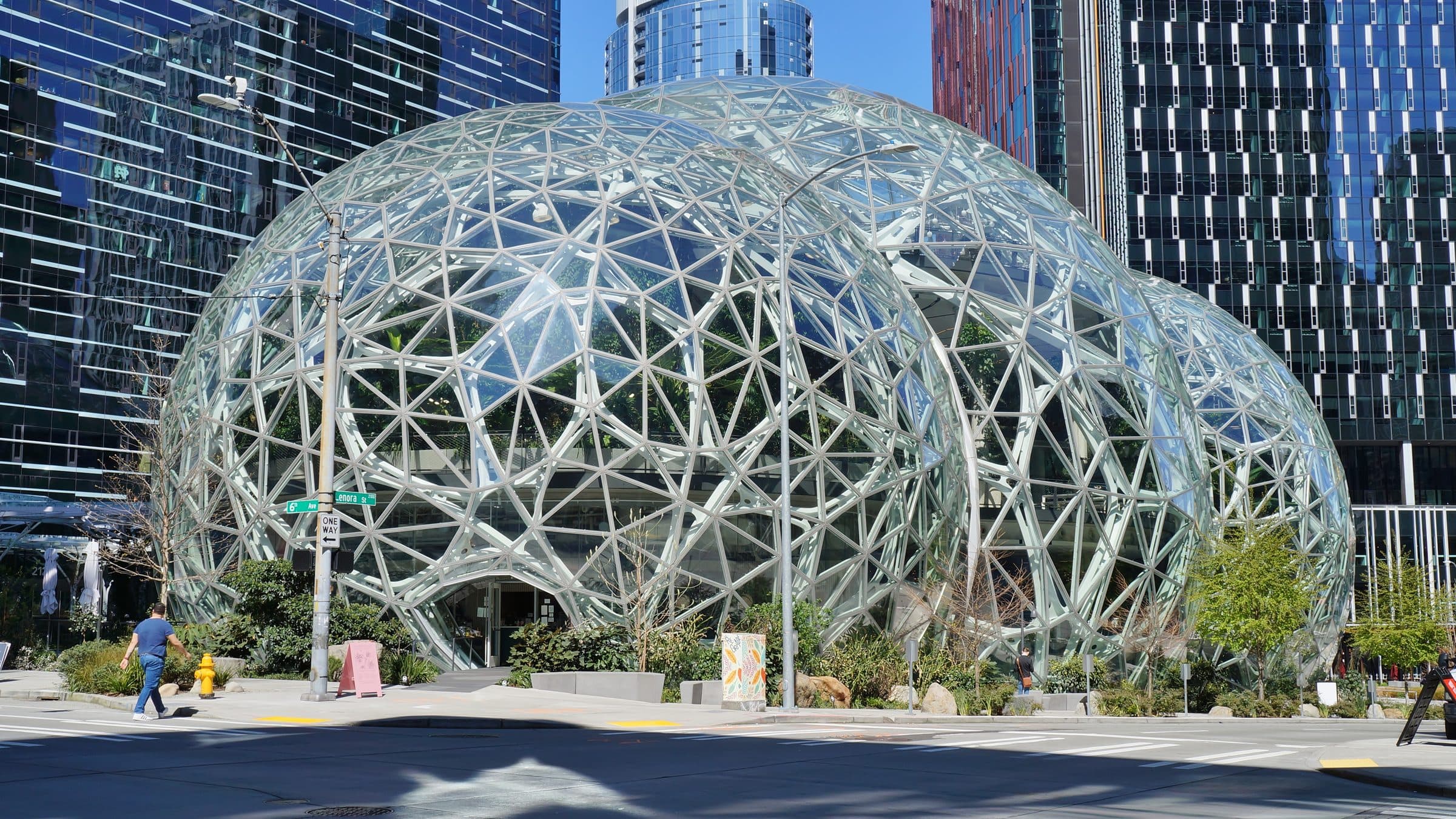
- Cover photograph: the Amazon Spheres, Seattle, by SounderBruce. Licensed CC BY-SA 4.0. (opens in a new tab)Wikimedia CommonsAccessed 11 August 2026
Subscribe
Each note by email when it is published.