Airbnb's first beat in a year is not quite a beat
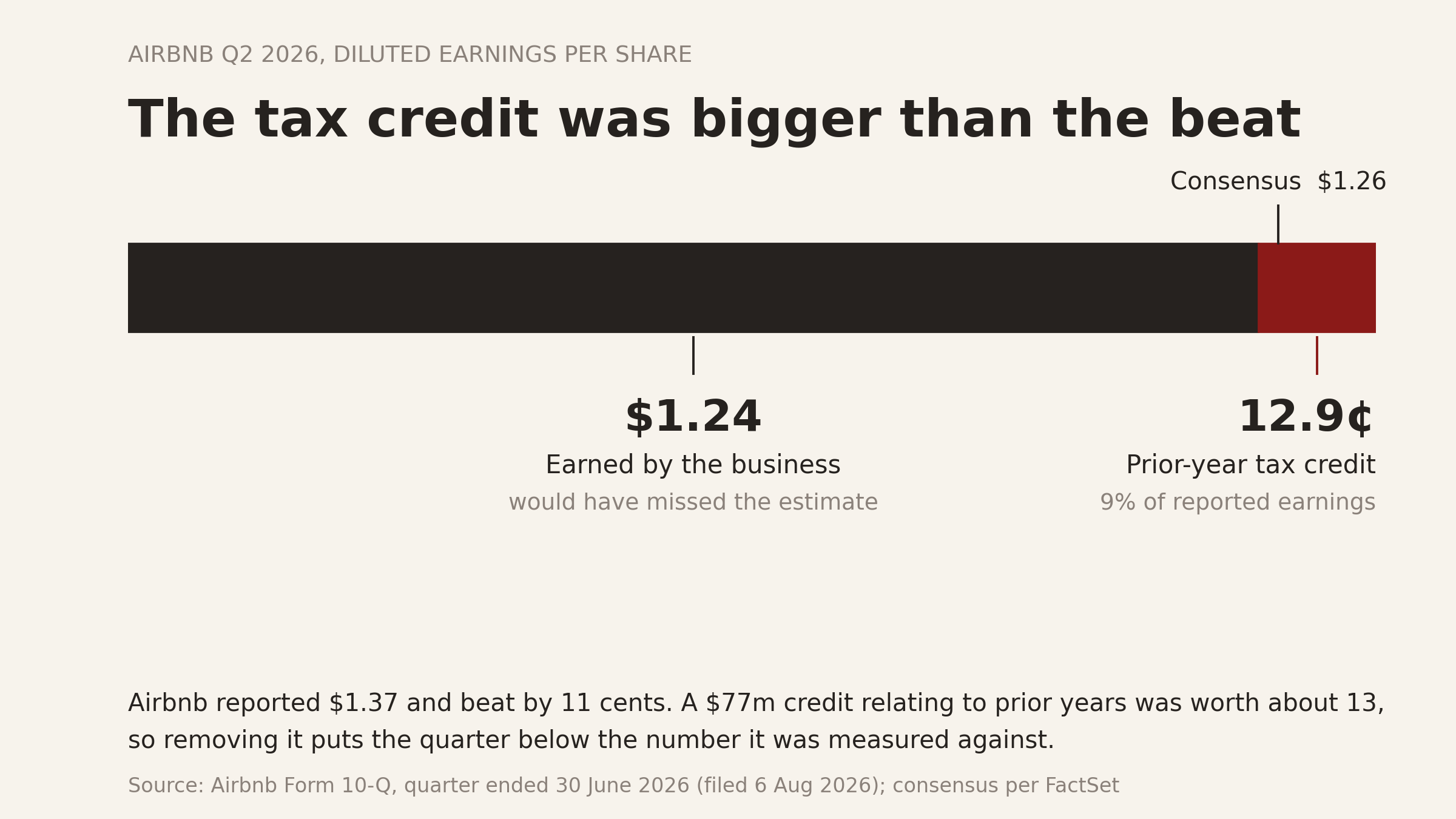
The quarterly report filed the same day discloses a $77 million tax credit relating to prior years. Per share it is worth more than the margin by which Airbnb beat estimates.
Airbnb reported second quarter results on 6 August. Revenue was $3.61 billion and diluted earnings were $1.37 a share, against a FactSet consensus of $1.26. The shares rose more than 11 percent in after-hours trading, on what was widely reported as the company's first earnings beat after three consecutive quarters of missing estimates.
The explanation comes first, because it is short. The quarterly report filed with the Securities and Exchange Commission the same day discloses a $77 million tax benefit "related to recently published guidance impacting prior year taxes." Spread across 597 million diluted shares, that benefit is worth about 12.9 cents. The beat was 11 cents. Remove the benefit and the quarter produces roughly $1.24 a share, below the estimate it is measured against.
The rest of this note sets out where that figure comes from, what the quarter did achieve, and why the event now most often named as its cause had barely begun when the quarter closed.
Where the earnings growth came from
Airbnb's pre-tax profit rose 15 percent, from $779 million to $897 million. Its net profit rose 27 percent, from $642 million to $816 million. Diluted earnings per share rose 33 percent.
Those three numbers describe the same quarter. The distance between them is the finding above, drawn in full.
Three growth rates, one quarter
Percent change vs Q2 2025
Bar chart plotting 1 series — Change vs Q2 2025 (%) — across 3 points of measure. Values range from 15.1% to 33%. The full figures are available in the data table below the chart.
Pre-tax profit is the measure a tax benefit cannot flatter. Everything above it comes from tax and a smaller share count.
Source Airbnb, Form 10-Q for the quarter ended 30 June 2026
Two things sit in the gap. The first is the share count, which fell from 626 million to 597 million after $1.1 billion of buybacks in the quarter. The second, and larger, is tax.
The provision for income taxes fell from $137 million to $81 million even as pre-tax profit grew. That moves the effective tax rate from 17.6 percent to 9.0 percent in a single year. This part depends on no estimate at all: pre-tax profit grew 15 percent, earnings per share grew 33, and the gap between those two figures is the subject of this note.
Two things that could undo this comparison
The first is the basis of the estimate. Consensus figures sometimes refer to an adjusted number rather than a reported one. Here they cannot. The filing states that Airbnb's non-GAAP measures are "Adjusted EBITDA, Adjusted EBITDA Margin, FCF, and FCF Margin." The company publishes no adjusted earnings per share, so an earnings-per-share estimate can only refer to the reported diluted figure.
The second is that there is no single consensus, and this note should not pretend otherwise. FactSet carried $1.26, which is the figure the result was reported against and the one used here. AlphaStreet carried $1.25. Zacks, which polls a narrower panel, carried $1.20. Against the first two, a quarter stripped of the tax benefit falls short. Against the lowest of them it does not. A reader who prefers the Zacks figure should discount the framing of this note accordingly, and is left with the arithmetic in the section above, which no estimate can move.
The business did grow
None of the above says the quarter was weak, and the operating figures should be stated plainly.
Revenue grew 17 percent. Income from operations grew 24 percent, from $612 million to $758 million, because revenue growth outpaced a 15 percent rise in costs. Free cash flow was $1.25 billion against $962 million a year earlier. Nights and Seats Booked rose 10 percent to 148 million.
Airbnb had a good quarter. The narrower question is whether the specific number that ended the streak, and moved the shares 11 percent, came from that performance. It largely did not.
The gap between bookings and nights
Gross booking value rose 16 percent to $27.2 billion. Nights and Seats Booked rose 10 percent. The difference of roughly six points is price, which Airbnb reports as average daily rate.
Bookings grew faster than nights
Percent change vs Q2 2025
Bar chart plotting 1 series — Change vs Q2 2025 (%) — across 2 points of metric. Values range from 10.4% to 16.2%. The full figures are available in the data table below the chart.
The gap between the two is price. Airbnb attributes part of it to a payment product rather than to underlying rates.
Source Airbnb, Form 10-Q for the quarter ended 30 June 2026
The filing attributes part of that price increase to a specific product. "The increase in ADR was driven in part by the continued adoption of RNPL."
RNPL is Reserve Now, Pay Later, launched in 2025 and expanded internationally this year. It allows a guest to book with no payment at the time of booking. Three disclosures about it appear in the report.
The first is cancellations. RNPL bookings "have experienced higher cancellation rates than historic bookings in which some or all of the cash was received at the time of booking."
The second is measurement. As adoption grows, "the timing among GBV, revenue, and cash receipts may become less correlated." Gross booking value counts a booking when it is made. Revenue is recognised when the guest checks in. A product that separates the two widens the distance between the headline number and the money.
The third is cash. Unearned fees grew more slowly than gross booking value during the first half, because under RNPL "payment is collected closer to check-in rather than at booking. Accordingly, unearned fees are not recorded, and operating cash flows are not generated until payment is received."
Airbnb does not disclose what share of bookings now use RNPL. Without it, the size of the effect on average daily rate cannot be measured from outside the company.
The World Cup is in the next quarter
Attention has settled on the 2026 World Cup as an explanation for the quarter. The timing does not support that.
The tournament ran from 11 June to 19 July 2026, hosted by sixteen cities across the United States, Canada and Mexico. Airbnb's second quarter ended on 30 June. Because revenue is recognised at check-in rather than at booking, only stays completed by that date fall into the quarter reported on 6 August. The group stage ended on 27 June. Every knockout round from the Round of 16 onward, and the final on 19 July, falls into the third quarter.
The report itself makes no claim about the tournament. The words World Cup, FIFA and tournament do not appear in it.
The regional detail points the same way. Gross booking value grew "across all regions, led by Latin America and Asia Pacific, with North America and EMEA growing more moderately." Eleven of the sixteen host cities are in the United States and two are in Canada. Had the tournament driven the quarter, North America would be an unlikely candidate for the slower half.
The effect is more plausibly ahead of the company than behind it, which places it inside the full-year guidance Airbnb raised on the same day rather than inside the results it reported.
What would settle it
Three disclosures would close the open questions, and none of them exists today.
The share of gross booking value transacted through RNPL would allow a reader to size the price effect rather than infer it. A breakout of event-driven demand would show what the tournament contributed and when. And a statement of the expected effective tax rate for the remainder of the year would indicate whether 9.0 percent is a level or a moment.
The third quarter report will answer part of this on its own. It will contain the World Cup check-ins, and it will show whether the tax rate returns toward the 17.6 percent of a year ago.
Until then the checkable facts are these. A tax benefit relating to prior years added about 13 cents to a quarter that beat the consensus it was measured against by 11. Pre-tax profit, the measure that tax cannot flatter, grew 15 percent while earnings per share grew 33. And the event most likely to lift the company's year had, at the close of the quarter it just reported, barely begun.
Sources
- Form 10-Q for the quarterly period ended 30 June 2026 (opens in a new tab)Airbnb, Inc. via SEC EDGARAccessed 6 August 2026
- FIFA World Cup 26 match schedule, fixtures and results (opens in a new tab)FIFAAccessed 6 August 2026
Subscribe
Each note by email when it is published.