AI Spending Could Surpass $750 Billion This Year
JPMorgan strategists said AI would take well over half of the roughly $1.5 trillion that S&P 500 companies will spend on buildings and equipment in 2026, and half of $1.5 trillion is $750 billion. No company in the index files a number against which that can be checked.
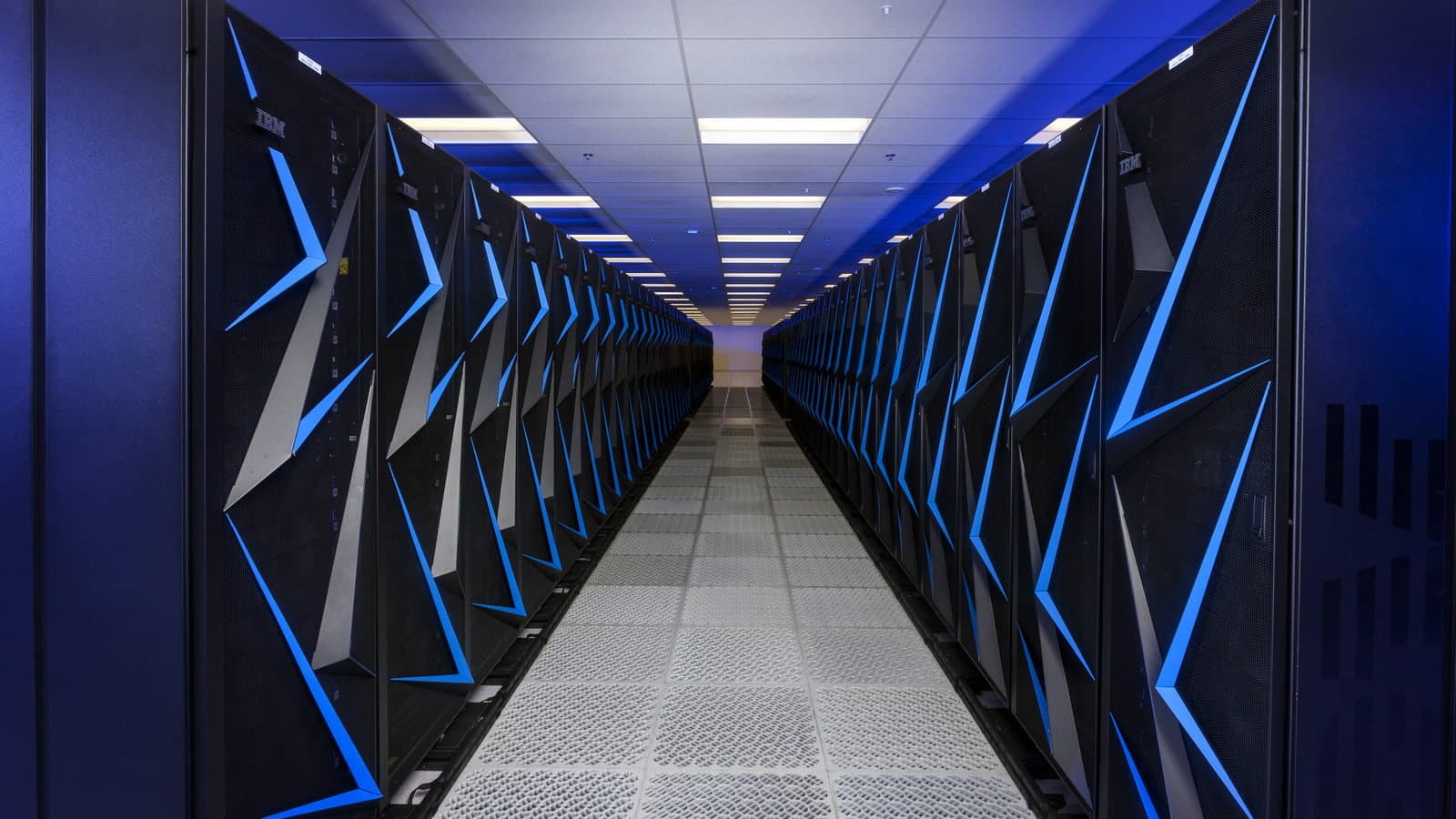
Photo: U.S. Department of Energy / Lawrence Livermore National Laboratory, public domain
The number now attached to artificial intelligence spending this year is $750 billion, and it is worth knowing where it came from. On 10 August 2026, JPMorgan strategists led by Dubravko Lakos-Bujas raised the firm's year-end target for the S&P 500 to 8,000 from 7,800, arguing that the large cloud companies are turning the money they sink into buildings and equipment back into revenue faster than anyone expected. In the same note, those strategists said that AI would account for well over half of the roughly $1.5 trillion that companies in the index would spend in 2026 on the long lived assets that accountants call capital spending: land, buildings, machinery and servers.
Half of $1.5 trillion is $750 billion, and that is the entire derivation. JPMorgan did not publish a $750 billion forecast for AI, because what its strategists published was a share of a total, expressed as a rounded phrase, and the dollar amount now in circulation is arithmetic that other people performed on that phrase. Since the phrase was well over half, $750 billion is a floor rather than a central estimate.
Both of the inputs to that sum are estimates rather than disclosures. The $1.5 trillion is JPMorgan's own forecast of what the index will spend in a year that is not yet finished, rather than a tally of reported numbers, and the share of it that counts as AI is a judgement about which spending qualifies. That second judgement is by far the harder one, because no company in the index reports the answer.
What the four largest spenders reported
All four of the largest spenders report the cash they put into property and equipment as a single line in their cash flow statements, and the chart below sets out what those lines say for the six months to 30 June 2026. Amazon's is much the largest at roughly $98 billion, with Alphabet next and Meta the smallest of the four. Microsoft's financial year ends in June rather than December, so its calendar half has to be assembled out of two separate quarterly filings before it can be compared with the others.
Together the four put roughly $295 billion of cash into property and equipment in the first half of 2026, close to double what they spent in the same period a year earlier, and every component of that total is a reported number sitting in a filed document.
Cash purchases of property and equipment, first half of the year
$ billion
Bar chart plotting 2 series — H1 2025, H1 2026 — across 4 points of company. Values range from 29.48 to 98.41. The full figures are available in the data table below the chart.
Cash paid for property and equipment in the six months to 30 June. Microsoft's calendar figures are derived from its fiscal quarters, since its financial year ends on 30 June. None of the four discloses how much of this relates to AI.
Source Company 10-Q and 10-K filings, SEC EDGAR
The full year can be bracketed from those same filings. In 2025 the four spent about a third more in the second half of the year than in the first, and repeating that pattern in 2026 would take them to roughly $692 billion for the calendar year, while assuming that the second half merely matches the first would leave them somewhere near $590 billion. Meta's own guidance implies a second half well above its first, which points towards the upper end of that range.
That range of roughly $590 billion to $692 billion is the entire capital budget of the four biggest disclosers, and it includes every warehouse, office and network upgrade that has nothing whatever to do with AI. The JPMorgan phrase implies more than $750 billion of AI spending alone, spread across the whole index. That is not a contradiction, since the chipmakers, the utilities building new power capacity and several hundred other companies sit in the index too, but the gap between the two has to be filled by spending that no filing anywhere identifies as AI.
No company discloses a separate line for AI
None of those filings attaches an AI figure to any part of the money. Alphabet's quarterly report to the Securities and Exchange Commission says only that its spending "primarily reflected investments in technical infrastructure", and goes on to describe multi-year projects covering land, buildings and servers. Meta guides to approximately $130 billion to $145 billion for 2026 "to support our AI efforts and core business", with no split offered between the two. Amazon gives no guidance at all, and the only breakdown it provides is by business segment rather than by purpose, with most of the first half's additions sitting inside its AWS cloud division. The word that recurs throughout all of these documents is infrastructure, and the split between an AI server and a warehouse conveyor belt is simply not disclosed, so an analyst who produces a number for it is estimating rather than reading.
The cash number is not the spending number
Even the disclosed line understates what is actually being acquired. Amazon's supplementary notes show equipment that it has taken delivery of but not yet paid for, and that unpaid balance rose by about $21 billion in the six months to June 2026, against roughly $1.5 billion in the same six months a year earlier. It picked up several billion dollars more of equipment under the long term rental contracts that accounting rules treat as purchases, known as finance leases. Cash purchases over the twelve months to June came to $173 billion, and the equipment acquired over that stretch was materially more than that.
Microsoft has the same gap in a slightly different form. Its accounts for the year to June 2026 show close to $116 billion of additions to property and equipment, while a note buried in the same filing records a further $24.61 billion of datacentre capacity taken on through exactly those lease arrangements. Leases of that kind put capacity on the balance sheet without ever passing through the cash a company reports spending on investment. Meta, for its part, guides on a third measure again, one that folds its own lease payments into the cash line and so produces a slightly larger first half figure than its cash flow statement does.
Three companies, three definitions of the same word. Anyone building a total for the whole index, JPMorgan included, has to choose one of those definitions, and the choice is nowhere disclosed, which means the numbers everyone quotes are adding up things that are not the same measurement.
What can actually be checked
The JPMorgan forecast may well prove right, since capital spending at the largest disclosers has almost doubled year on year and the financing behind it is plainly visible in the filings. The point here is a narrower one. The $750 billion is arithmetic performed on a rounded phrase inside a bank's estimate, the reported spending it is meant to describe arrives in three incompatible definitions, and there is no disclosure anywhere in the index against which the AI portion of it can be checked.
Sources
Subscribe
Each note by email when it is published.